In August, New Zealand's public broadcaster RNZ announced job cuts in response to reduced funding. By November the picture had changed sharply. RNZ disclosed a $12 million budget shortfall, more than 25 times the $470,000 loss it had expected for the year. Its chief financial officer had resigned in early October, its chief executive left six weeks ahead of schedule, an independent review was commissioned, and expected job losses doubled to 58. A government minister said publicly that it was "not credible" the board had missed the problem.
The independent review hasn't reported yet, and it would be unfair to prejudge it. But notice how quickly public attention landed on the board. That instinct is understandable, and it is also incomplete. A shortfall of that size passes through many hands before it reaches a boardroom. Financial controls, budget approvals, reporting lines, ministerial expectations, and funding agreements all play a part. When something goes this wrong, it is rarely one body that failed. It is the system.
That system has a name. It's governance, and it is much bigger than a board.

Governance is how an organization decides
Governance is the set of roles, rules, and routines that determine who can decide what, how authority is delegated, and how people are held accountable for the results. A board or oversight body sits at the top of that system. But most of the decisions that shape an organization's direction and protect its mission are made far below it, every single day.
That's why governance matters just as much to a city agency, a global NGO, or a certified B Corp as it does to a community nonprofit. The structures look different. The questions are the same.
The five layers of governance
Most mission-driven organizations operate within five layers of governance, whether or not they have named them.
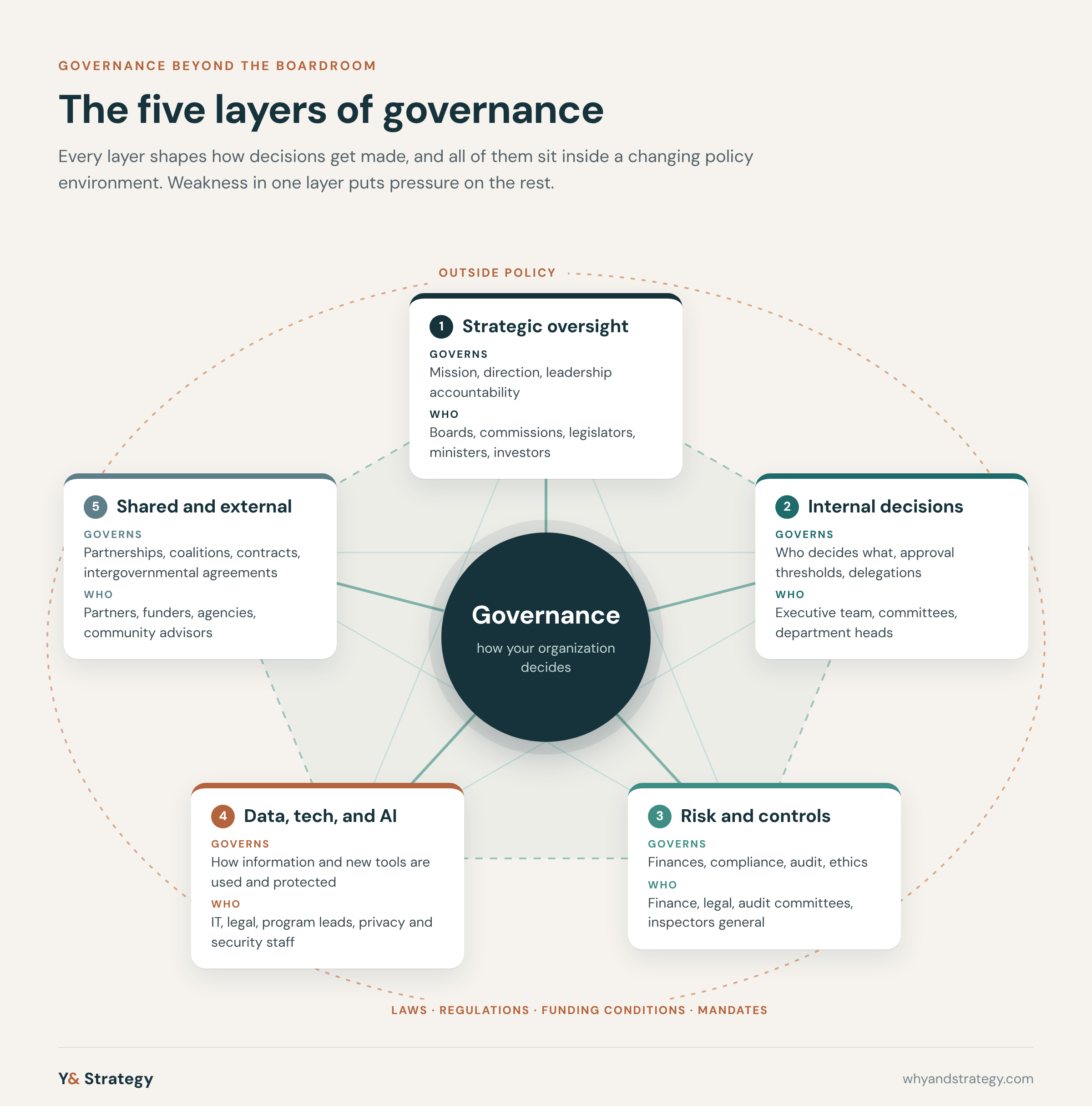
Let’s look at each in turn:
Strategic oversight. This is the layer most people picture when they hear the word governance. It sets the mission, approves long-term direction, and holds top leadership accountable for results. In a nonprofit or NGO, that usually means a board of directors. In a public agency, it may be a legislature, a commission, a minister, or an elected executive. In a mission-driven business, investors and directors play the role. Whatever the form, strong oversight focuses on direction and accountability, not daily operations, and it receives information early enough to act on it.
Internal decision-making. This is where most governance actually happens. It covers who can approve a hire, sign a contract, launch a program, or commit funds, and at what threshold a decision must move up the chain. When these rules are written down and understood, people act with confidence and leaders spend their time on the decisions that truly need them. When they aren't, decisions stall, escalate by default, or get made twice by different people. A clear delegation of authority is one of the simplest and most powerful governance tools an organization can have.
Risk and controls. This layer protects the organization's resources and its credibility. It includes financial controls, budget monitoring, audit, legal compliance, ethics policies, and safe channels for raising concerns. It is often treated as back-office work, yet it is usually where serious problems first become visible. When risk and controls are strong, warning signs reach leadership and oversight bodies while there is still time to respond. When they are weak, the first sign of trouble is often a public one.
Data, technology, and AI. This is the fastest-growing layer of governance, and in many organizations the least developed. It decides how information about clients, constituents, donors, and staff is collected, stored, shared, and protected. It also decides how new tools, including artificial intelligence, are evaluated and used. For organizations that serve vulnerable communities or hold public trust, these choices carry real ethical weight. Good governance here doesn't mean slowing innovation. It means deciding deliberately, with clear owners and guardrails, instead of letting each team improvise.
Shared and external. Few mission-driven organizations achieve their goals alone. Coalitions, joint programs, government contracts, intergovernmental agreements, and funder partnerships all create shared decisions that no single organization fully controls. This layer defines how those decisions get made, how performance is reviewed, how disagreements are resolved, and how a partnership ends if it needs to. It also includes the community advisory bodies that give the people you serve a real voice. Partnerships built on goodwill alone tend to struggle the first time interests diverge.
Weakness in any one layer puts pressure on the others. A strong board can't compensate for unclear internal approvals. Excellent financial controls can't save a partnership that never defined who decides. And a well-run organization can still be blindsided if no one is watching how outside policy is changing around it.
Policy is often forgotten until it is felt
Policy touches governance in two directions, and mission-driven organizations need to manage both.
Outside policy shapes your governance. Laws, regulations, funding conditions, procurement rules, and executive actions all set the boundaries within which you operate. When they change, your obligations can change overnight. The National Council of Nonprofits, for example, maintains a running tracker of recent federal executive orders affecting nonprofit funding, staffing, and operations, some of which took effect immediately while others were challenged in court. Public agencies feel this most directly, since a new statute or budget act can rewrite a mandate within a single legislative session. Mission-driven businesses face their own version through evolving disclosure rules, certification standards, and investor requirements. Organizations with strong governance treat these shifts as strategic questions, not compliance afterthoughts. They decide in advance who monitors the policy environment, who assesses the impact, and who has authority to change course.
Your governance shapes the policy you influence. Many mission-driven organizations advocate, advise lawmakers, implement public programs, or take public positions on issues they care about. Each of those activities raises governance questions. Who decides when the organization takes a public stance? What evidence review happens first? How are legal limits on advocacy and lobbying observed? How does a public agency translate a new law into consistent practice across divisions and regions? Without clear answers, policy work becomes either paralyzed or improvised.
And then there are internal policies, the written rules an organization governs itself by. Most organizations have plenty. The trouble is that many exist only on paper, with no owner, no review date, and no connection to how people actually work. A policy no one follows isn't governance. It's a liability waiting to be discovered.
Five signs your governance system is straining
Decisions stall or escalate by default. Without clear delegations of authority, routine choices drift upward until leaders are deciding things they shouldn't need to see.
Policies say one thing and practice says another. Staff follow informal workarounds because the formal rules are outdated, unclear, or unknown.
Oversight runs on surprises. Leaders, boards, or oversight bodies learn about serious problems at the annual audit, the program evaluation, or the public hearing, when it is too late to change course.
Outside policy changes catch you flat-footed. A regulatory shift, a funding condition, or a new mandate arrives and no one owns the response.
Partnerships run on goodwill alone. Coalitions, joint programs, and contracts launch without agreed rules for decisions, disputes, or exits, and the first real disagreement exposes the gap.
You can still strengthen governance across the whole organization
Map your governance system. List the bodies, committees, and roles that make significant decisions, and what each is responsible for. Many organizations discover duplication, gaps, and committees no one remembers creating.
Write a clear delegation of authority. Spell out what each level can approve on its own, the financial thresholds that require escalation, and which decisions are reserved for the board, the agency head, or another oversight body.
Give every policy an owner and a review date. Keep a single register of internal policies, assign each one to a named owner, and review them on a regular cycle. Retire what no longer applies.
Build a policy-watch rhythm. Assign responsibility for monitoring legal, regulatory, and funding changes, and bring the most significant ones to leadership quarterly with a short assessment of impact and options. For organizations that influence policy, define who approves public positions and how they are vetted.
Govern partnerships at the start. Before launching a coalition, joint program, or major contract, agree on who decides what, how disagreements are resolved, how performance is reviewed, and how either party can exit.
As always, changes to bylaws, statutory obligations, or other governing documents should be reviewed with counsel.
Governance is how a mission survives change
Leaders change. Funding shifts. Administrations turn over and laws are rewritten. Good governance is what allows a mission-driven organization to absorb those changes without losing its way. It gives people at every level the clarity to act, gives oversight bodies the insight to intervene early, and keeps the organization's commitments intact when the ground moves.
That is what governance offers when it is designed well. Not more meetings or more paperwork, but better decisions, made by the right people, at the right time.
Where Y& Strategy comes in
We help nonprofits, NGOs, public agencies, and mission-driven businesses design governance that strengthens strategy at every level. That includes clarifying decision rights and delegations of authority, aligning boards and oversight bodies with organizational direction, building rhythms to anticipate policy change, and setting up partnerships for shared success. We work within your mandates, governing documents, and funder or investor commitments, and alongside your counsel where formal changes are needed.
If decisions in your organization feel slow, unclear, or surprising, let's talk.
Sources:
National Council of Nonprofits, "The Impacts of the Recent Executive Orders on Nonprofits"