Mission-driven organizations rarely grow in a straight line. They grow when a major grant lands, when a government contract expands their service area, when a crisis demands a rapid response, when a merger or partnership adds new programs overnight, or when a legislature hands an agency a new mandate.
Each of those moments is a sign that the work matters. Each one also adds people, programs, and obligations to a structure that was never designed to hold them. Over time the organization becomes a patchwork, with teams added wherever the funding or the mandate happened to land.
The result is familiar to anyone who has led in this sector. Everything takes longer. The same committed people are always exhausted. Programs that should reinforce each other operate as separate worlds. And leaders spend more time managing the structure than advancing the mission.
That isn't a failure of people or commitment. It's a sign that your mission has outgrown your org chart.

Seven warning signs your structure is straining
Most leaders feel the strain long before they can name it. These are the patterns we see most often across nonprofits, NGOs, public agencies, and mission-driven businesses.
Your structure mirrors your funding, not your mission. Teams are organized around individual grants or contracts, so staff split their time across four funding streams and programs serving the same community barely talk to each other. The org chart tells the story of how money arrived, not how impact happens.
Every decision climbs to the top. Choices large and small wait for the executive director, the CEO, the agency head, or the country director. That leader is stretched thin, and the organization has learned that nothing moves until they weigh in.
Nobody is sure who decides. Headquarters and field offices each believe a decision is theirs. Program and finance pull in different directions. In public agencies, divisions with overlapping mandates wait on each other. Work stalls in polite limbo while the same question returns to the leadership meeting month after month.
Your most committed people are burning out. In mission-driven work, people rarely say no. Work flows to whoever cares most and delivers most reliably, until those people leave and take years of relationships and institutional knowledge with them.
Programs outgrew the backbone. Program teams expanded with each new grant or mandate, but finance, HR, data, and compliance stayed the same size. Reporting deadlines become fire drills, and program staff absorb administrative work they were never hired to do.
Partners and funders get mixed messages. Different teams make different commitments to the same funder, community partner, or sister agency. External stakeholders start to see the seams before leadership does.
Subject matter experts are struggling as managers. Talented clinicians, case workers, researchers, and policy specialists were promoted for their expertise, then handed teams with little support. They are doing their old job and their new one at the same time.
If even just three of these sound familiar, your organization has likely reached the point where informal workarounds can no longer carry the load.
Why a reorg is usually the wrong first move
When the strain becomes obvious, the instinct is to redraw the org chart. New divisions, new reporting lines, new titles.
In this sector, that instinct deserves extra caution. Restructuring a mission-driven organization is rarely simple. Positions may be tied to specific grant budgets. Public agencies work within civil service rules, collective bargaining agreements, and statutory requirements. Board approval, funder notification, and community relationships all hang on familiar names and roles. A reorganization can consume a year of leadership attention and unsettle the very staff and partners you most need to keep.
And it frequently misses the real problem. The boxes and lines were rarely the issue. The issue was how decisions get made, how leaders work together, and how work is distributed across the organization.
The good news is that most of that can be fixed without moving a single box.
Five fixes that don't require a reorg
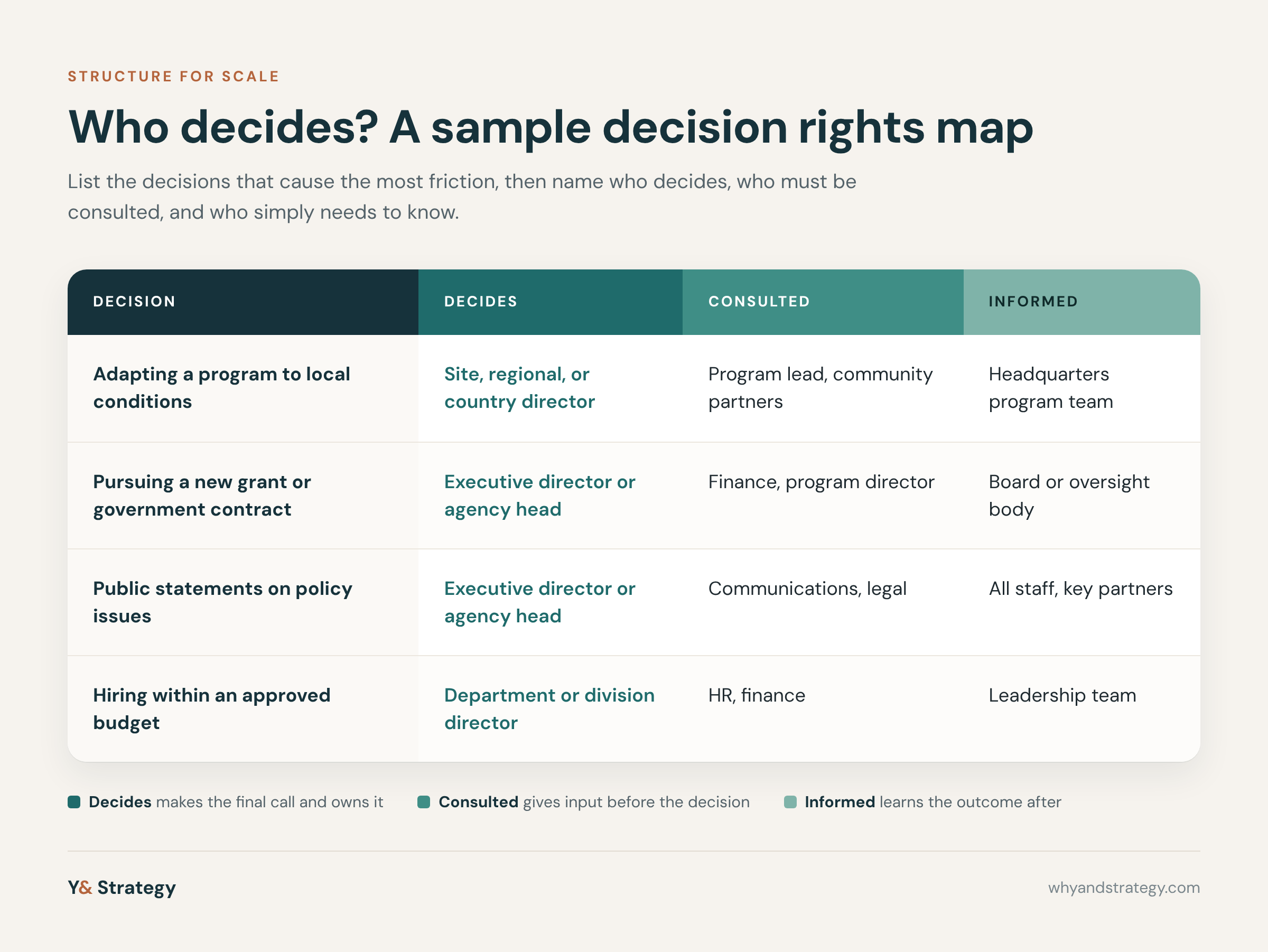
1. Make decision rights explicit. List the 10 to 15 decisions that cause the most friction or delay, and write down who decides, who must be consulted, and who simply needs to know. It sounds almost too simple, yet it resolves a surprising amount of tension, especially between headquarters and the field or between central offices and divisions. A short version might look like this.
2. Organize work around outcomes, not funding streams. Funding streams still need careful tracking for compliance and reporting. That is a finance function, and it doesn't have to dictate how teams are organized. Cross-program teams built around a population, a place, or an outcome can coordinate services while finance continues to allocate time and costs to the right grant. Staff stop feeling like they work for four funders and start feeling like they work for one mission.
3. Build a leadership rhythm that connects the whole organization. A growing organization needs predictable moments for different kinds of conversation. A short weekly or biweekly leadership meeting handles operational issues. A monthly session takes on one or two strategic questions in depth. A quarterly review checks progress against priorities and makes real tradeoffs. For organizations with field offices, regional sites, or multiple divisions, the rhythm should deliberately include those leaders, not just the people at headquarters.
4. Strengthen the backbone and invest in managers. Mission-driven organizations are often pressured to keep administrative costs as low as possible, and growth exposes the cost of that pressure. Look honestly at whether finance, HR, data, and operations have kept pace with programs, and make the case to your board and funders when they haven't. At the same time, give newly promoted managers clear expectations, coaching, and protected time to manage.
5. Clarify the line between governance and management. As organizations grow, boards, oversight bodies, and advisory councils sometimes drift into operational decisions, or step back from strategic ones. Agreeing on which decisions belong to the board and which belong to staff frees leaders to lead and lets the board focus on direction, accountability, and stewardship.
Growth should strengthen the mission, not strain the people
Growth in a mission-driven organization means more people served, more communities reached, and more public trust placed in your work. It shouldn't come at the cost of your most committed staff or your leaders' capacity to think. The organizations that grow well are rarely the ones with the cleverest org charts. They are the ones that decide clearly, delegate deliberately, and connect every part of the organization to the same mission.
Where Y& Strategy comes in
Our Structure for Scale work helps nonprofits, NGOs, public agencies, and mission-driven businesses align leadership rhythms, decision rights, and team design so they can grow without overextending their people. We start with how your organization actually works today, including the funding, governance, and regulatory realities you operate within, then design the lightest set of changes that will carry you to the next stage.
If your mission is outgrowing your org chart, let's talk.